Reporting Obligations
Reporting is where a compliance program meets the regulator. Four reports apply to the firms this knowledge base covers, and they are triggered by different things, run to different deadlines, and sit in different parts of the Act.
| Report | Triggered by | Deadline | Provision |
|---|---|---|---|
| SMR | A suspicion on reasonable grounds | 24 hours for terrorism related, otherwise 3 business days | s 41 |
| TTR | A threshold transaction, being physical currency of $10,000 or more | 10 business days | s 43(2) |
| CBM | Monetary instruments of $10,000 or more crossing the border | Before customs when carrying, before sending, or 5 business days of receipt | ss 53, 54, 56 |
| ACR | The end of a reporting period | 1 July to 30 September each year | s 47 |
Suspicious matter reports
An SMR is filed when a reporting entity forms a suspicion, or ought reasonably to have formed one, that a customer or transaction may relate to money laundering, terrorism financing, or another serious offence. The obligation is in s 41.
The threshold is suspicion, not proof. Where a reasonable person in the same position would form a suspicion, the obligation is triggered.
Deadlines run from when the suspicion was formed, under s 41(2):
- 24 hours for terrorism related suspicions
- 3 business days for all others
Where some (but not all) of the information required in the report is privileged, and the privilege belongs to someone other than the reporting entity, the non-terrorism deadline extends to 5 business days under s 41(2)(aa), and an LPP form accompanies the report. Terrorism financing stays at 24 hours regardless.
Threshold transaction reports
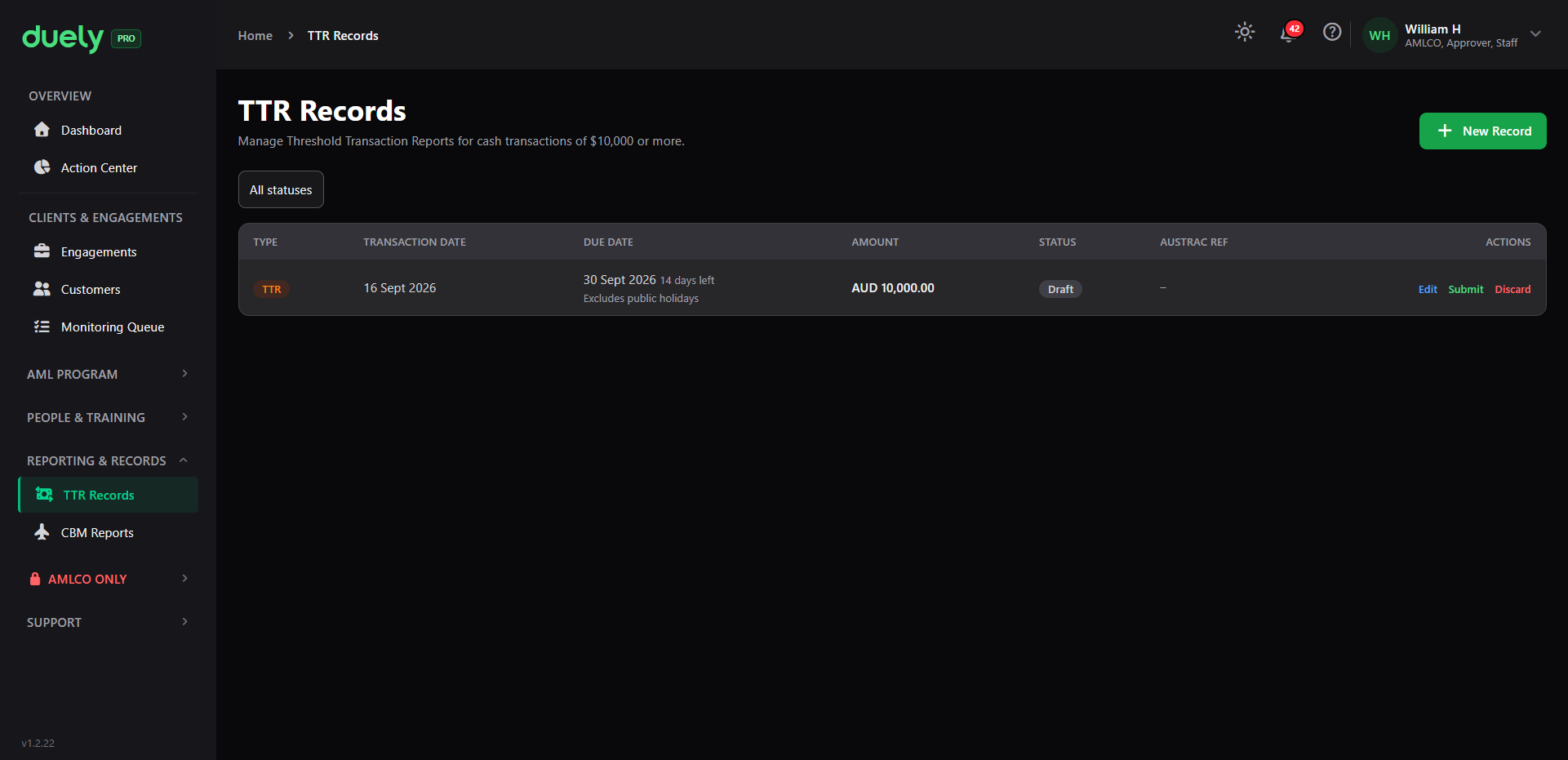
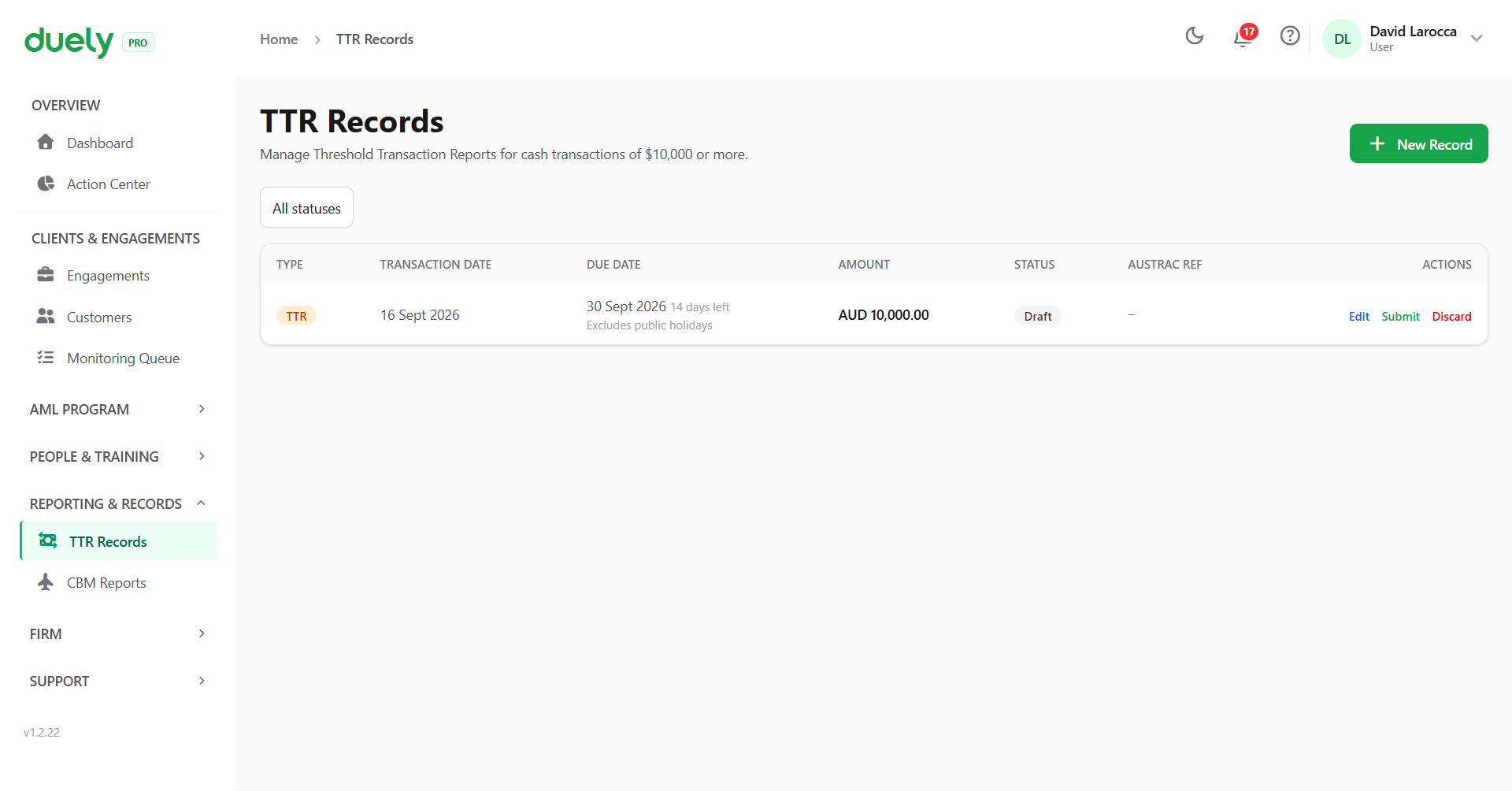
A TTR is required when a reporting entity provides a designated service involving a threshold transaction: physical currency of AUD $10,000 or more, received or paid out, in a single transaction. Each cash transaction is assessed on its own. If you suspect a customer is splitting cash to stay under the threshold, that calls for a suspicious matter report, and structuring is itself an offence under s 142. See AUSTRAC's Threshold transaction reports.
The deadline is 10 business days after the day the transaction takes place, under s 43(2).
Two neighbouring provisions are often confused with it:
- s 43(3)(aa) is the co-filing rule. Where information required in the report is reasonably believed to be privileged, the report must be accompanied by an LPP form.
- s 43(4) makes a failure to report within the deadline a civil penalty provision. It is not a deadline, and citing it as one is wrong.
Physical currency means coins and banknotes of Australia or a foreign country. It does not include electronic transfers, cheques, bank drafts, money orders, or card transactions.
Cross-border movement reports
A CBM is required when monetary instruments with a combined value of AUD $10,000 or more are moved into or out of Australia. Monetary instruments means physical currency and bearer negotiable instruments, such as bearer cheques, bearer bonds, travellers cheques, and money orders payable to bearer.
This obligation applies even where the movement is unrelated to a designated service, which is the part most firms miss. All reporting entities must report qualifying movements.
The deadline depends on the situation rather than the direction:
| Situation | Deadline |
|---|---|
| Carrying instruments through customs, arriving or departing | Before passing through customs |
| Mailing or shipping into or out of Australia | Before sending (Rules 9-12(3)(b) covers inbound) |
| Receiving instruments from outside Australia | Within 5 business days of receipt |
An inbound traveller carrying instruments reports before customs, not within 5 business days. The 5 business day window applies to instruments received from outside Australia.
Electronic transfers are excluded from CBM. Section 46 now covers reports of international value transfer services, and IFTI reporting continues under transitional rules. Those reports fall on the institution sending or receiving the transfer rather than on a professional services firm.
Annual compliance reports
Unlike the other three, the ACR reports on the firm's compliance with its obligations over a period, rather than on a single transaction or suspicion. The obligation is in s 47, with the periods set in the AML/CTF Rules.
Every reporting entity is on a financial year reporting period, with the report covering the previous financial year of 1 July to 30 June. The submission window is 1 July to 30 September each year.
For a Tranche 2 firm, the first report covers the 2026 to 2027 financial year and is due by 30 September 2027.
AUSTRAC's guidance for each report type is at Suspicious matter reports, Threshold transaction reports, Cross-border movement reports and Annual compliance reports.
How reporting works in Duely
Duely prepares the report record, and the firm lodges it with AUSTRAC. There is no direct submission rail. For suspicious matters, Duely produces the AUSTRAC XML payload and the AML/CTF Compliance Officer files it through AUSTRAC Online, recording the response reference back against the case.
| Step | Working by hand | In Duely |
|---|---|---|
| Knowing a deadline applies | Counted from a transaction date on a calendar, or noticed when someone asks. | The deadline is calculated when the record is created, and the AML/CTF Compliance Officer is notified as it approaches. |
| Building the report | Assembled at the end from emails, statements, and whatever the customer file holds. | Drawn from the matter record, so the customer details and verification history are already attached. |
| Preparing the lodgement | Re-keyed into AUSTRAC Online from a working document. | Suspicious matter reports export as an AUSTRAC XML payload; the officer files it and records the reference back. |
| Showing what was decided | A sent email and a copy in a folder, if both survived. | The decision, its rationale, and the person who made it are recorded and retained with the matter. |
Report records for threshold, cross-border and suspicious matters live in different places by design. Suspicious matter reporting is AMLCO-only, so it does not appear among the other report records.
Related pages
- Customer due diligence, because customer monitoring is what surfaces most suspicions.
- Record keeping, for how long reports and their working papers must be kept.
- Review and evaluation, for the effectiveness testing that checks whether reporting works.
- Filing a report, for the product walkthrough.