Appoint Your AMLCO
Every reporting entity must appoint an AML/CTF Compliance Officer. The appointment comes with two fixed clocks and an ongoing one.
The reformed regime places the program and officer duties in Part 1A of the AML/CTF Act 2006. Eligibility, including the fit and proper test, is in s 26J with the detail in Rules s 5-14. The 28 day designation duty is s 26K(1), and notifying AUSTRAC is s 26M.
Who can be appointed
Three requirements apply to the person, not the role title.
- An individual resident in Australia, where the firm provides services through a permanent establishment in Australia (s 26J(3)(a)). A named person, not a committee and not a shared title.
- Management level (s 26J(2)). The person must hold a position senior enough to influence how the firm approaches compliance, and to have access to the information and resources the role needs.
- Fit and proper (s 26J(3), with the matters set out in Rules s 5-14 under s 26J(4)), determined before appointing.
The fit and proper test is a judgement across seven considerations. The firm must consider all of:
- competence, skills, knowledge, diligence, expertise and soundness of judgement
- good character, honesty and integrity
- whether the person has been convicted of a serious offence
- whether a regulatory body has made adverse findings about them
- whether a regulatory body has found them to have engaged in serious misconduct
- whether they are bankrupt or have signed a personal insolvency agreement
- whether they have a conflict of interest that creates a material risk they will not act properly
Small firms are expressly not required to appoint an AML/CTF expert. The person needs management level competency, the capacity to learn the firm's money laundering and terrorism financing risks, and a path to acquire the rest through training and experience.
AUSTRAC sets out the role in AML/CTF compliance officer, and the checks behind it in Personnel due diligence (PDD).
The two clocks
| Clock | Requirement |
|---|---|
| 28 days | Designate an AML/CTF Compliance Officer within 28 days of first providing a designated service (s 26K(1)) |
| 14 days | Notify AUSTRAC of the appointment within 14 days, in the approved form (s 26M) |
The 28 day clock runs from the day the firm first provides a designated service, which for a Tranche 2 firm is no earlier than 1 July 2026. For the first officer, a transitional rule applies: a Tranche 2 firm must notify AUSTRAC by the later of 29 July 2026 or 14 days after it enrols.
The same duty applies on a change. If the officer leaves the role or stops being eligible, the firm must designate another officer within 28 days (s 26K(2)) and notify AUSTRAC of the change.
What the officer is responsible for
Section 26L and AUSTRAC's guidance give the officer these functions:
- overseeing and coordinating the firm's day-to-day compliance with the AML/CTF Act
- overseeing the firm's AML/CTF policies
- communicating with AUSTRAC on the firm's behalf
- reporting to the governing body
Firms commonly give the officer other tasks as well, such as managing reports to AUSTRAC, running staff training and its records, handling internal reports of suspicion, and overseeing record keeping.
The officer must also report to the governing body at least once every 12 months (Rules s 5-7(2)). AUSTRAC notes this works differently where the compliance officer and the governing body are the same person, which is common in small firms.
The officer cannot independently evaluate the program they run. AUSTRAC expects the evaluator not to be the AML/CTF Compliance Officer or a member of the compliance team. See Review and evaluation.
Recording it in Duely
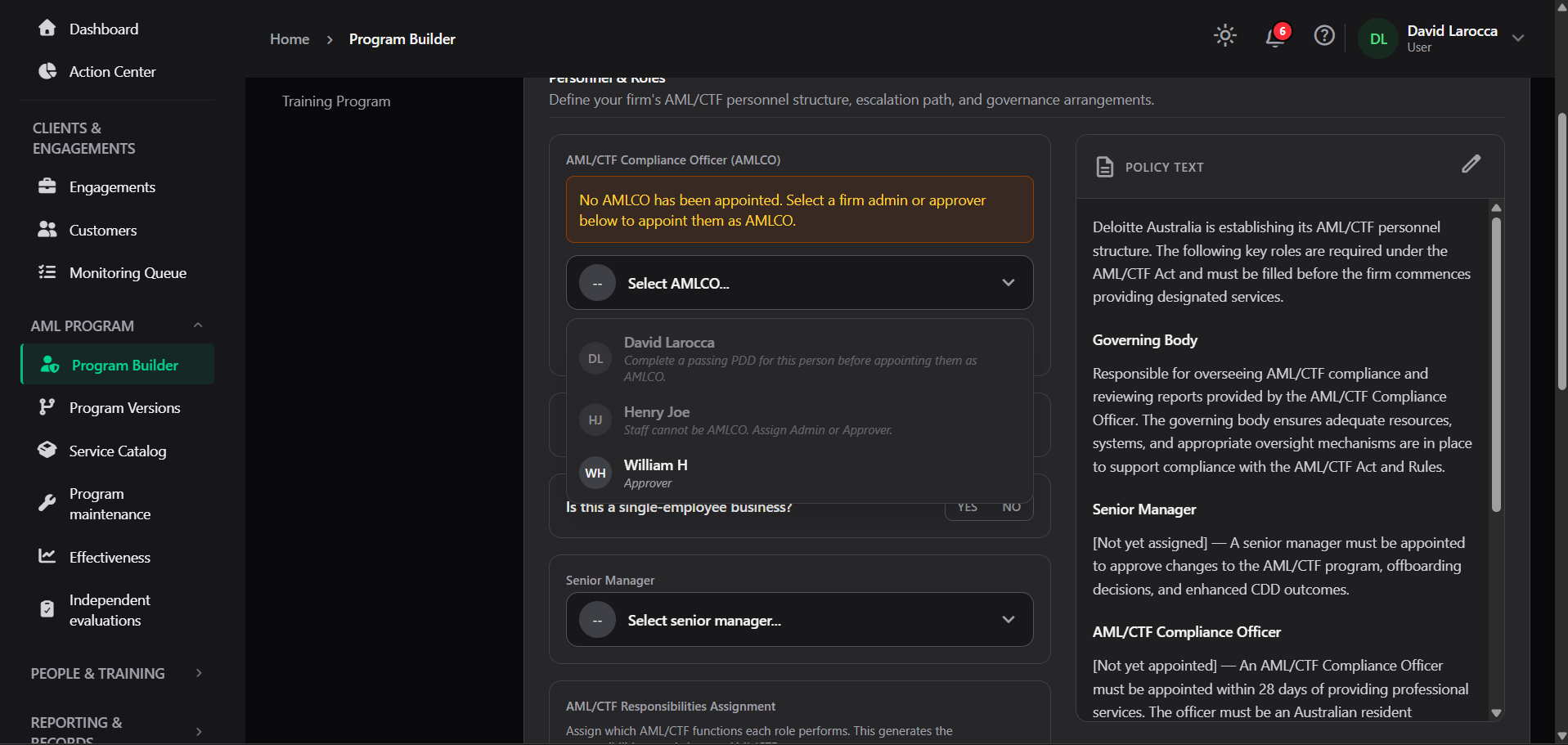
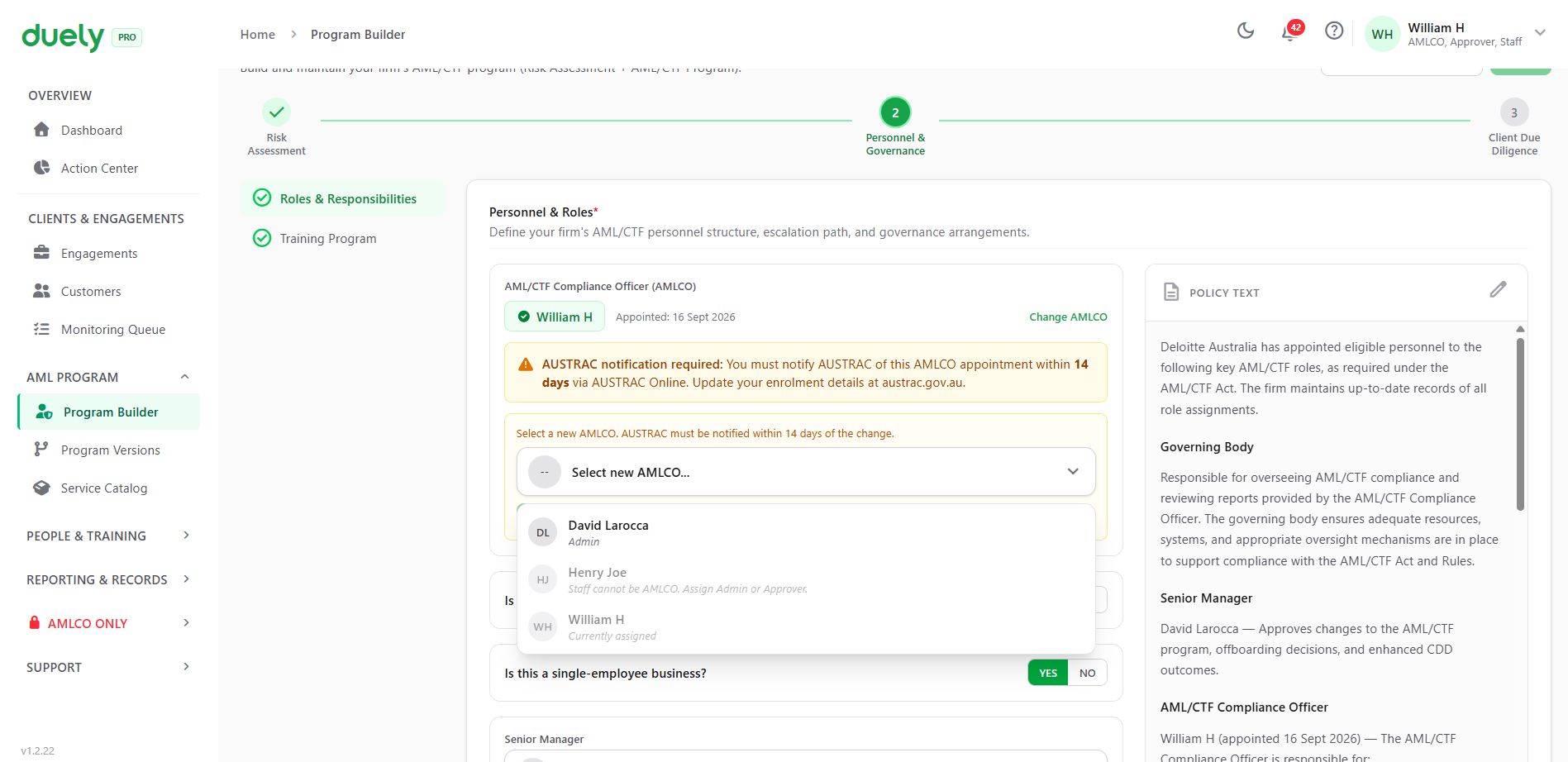
Appointment is made through the AML Program wizard, under personnel and governance. On a first appointment, the officer is recorded in the draft you are working on. If you already have an approved program that names a different officer, Duely creates a new draft, or updates the open one, so the program can be reviewed and approved again with the new officer on it.
The platform enforces two gates at the point of appointment. The candidate must already hold an eligible role, and their personnel due diligence must be current. Ineligible people still appear in the selection list, shown disabled with the reason stated, so the blocker is visible.
Related pages
- Roles and permissions, for the product's role model and who may be selected.
- Build your program, because Duely will not approve a program until an officer is appointed.
- Staff training, which the officer is responsible for.
- Review and evaluation, which the officer must not perform on their own program.